The day you hand your car to a transporter, one question matters more than any other: what happens if something goes wrong? The answer is not in the sales pitch. It is in two documents — the transport contract and the insurance behind it. Most quotes settle the matter in one line: “CMR insurance included”. That line hides a number every owner should know.
CMR: what the convention actually says
The CMR is the international convention governing road transport of goods between countries. It applies automatically to cross-border transports and defines the carrier's liability from the moment the vehicle is loaded to the moment it is unloaded: loss, damage, delay.
It is a solid legal base. But it has one feature few clients know about: the standard compensation is not calculated on the value of your vehicle.
The weight-based limit — the trap for a valuable car
Article 23 of the convention caps the carrier's standard liability at 8.33 SDR (Special Drawing Rights, the IMF's unit of account) per kilogram of gross weight — a little over €10 per kilo at current rates.
Run the numbers. A 1,500 kg grand tourer is covered, under the base regime, for roughly €15,000 — whatever its real value. For a €300,000 collector car, that is a twentieth of what it is worth. The convention allows higher compensation, but only if it is arranged explicitly: a declared value on the consignment note, or additional insurance on top of the legal minimum.
In other words, “CMR insurance included” tells you almost nothing by itself. What matters is what has been put in place above it.
Named ceilings, in writing
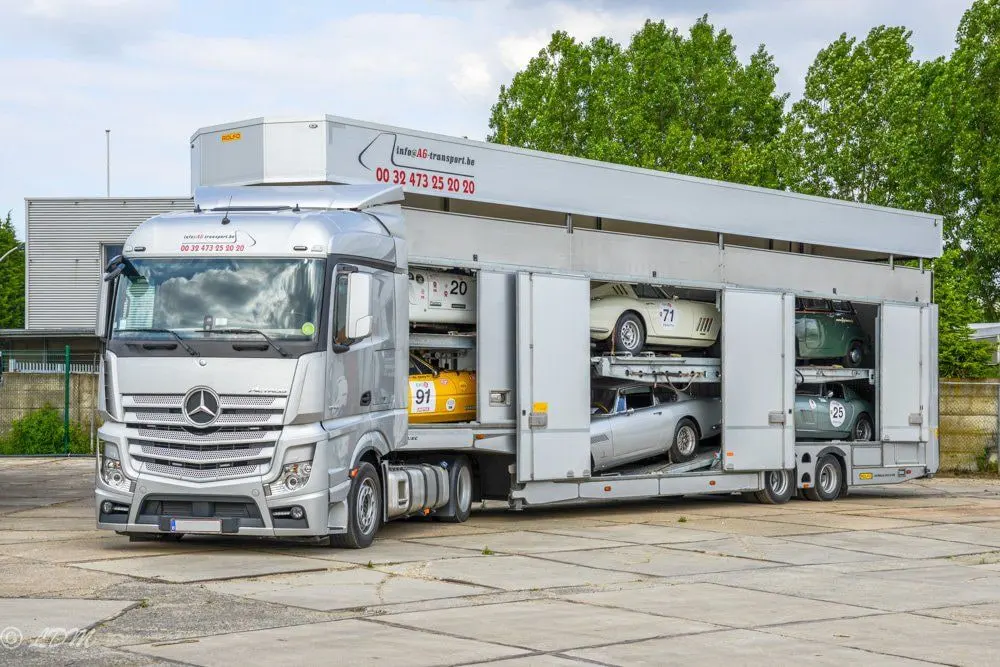
At e-motion, every transport runs under CMR conditions with reinsurance up to €850,000 per vehicle and €1,350,000 per transport, valid from loading to unloading. Those ceilings are not a verbal reassurance: they are confirmed in writing before departure, so you know exactly where you stand before the truck moves.
The insurance is matched by how the transport is run. Our trucks are our own and our drivers are our own, across roughly 1,700 transports a year. And where circumstances require the assistance of a fellow carrier, we remain solely liable to you: if anything ever needs to be resolved, there is one responsible party, not a cascade of intermediaries pointing at each other.
The “particular risk” clause: tell us everything
An insurance is only as good as the description of the risk. Some vehicles carry risks that standard handling does not anticipate: a carbon or aluminium body, a lowered chassis, a width over 1.95 m, a risk of dislocation on older frames.
Flag these before the mission. It lets us adapt the transport method, the price and the reserves — or tell you frankly when something should be handled differently. That conversation, before departure, is how surprises are avoided after arrival.
How damage is established — and settled
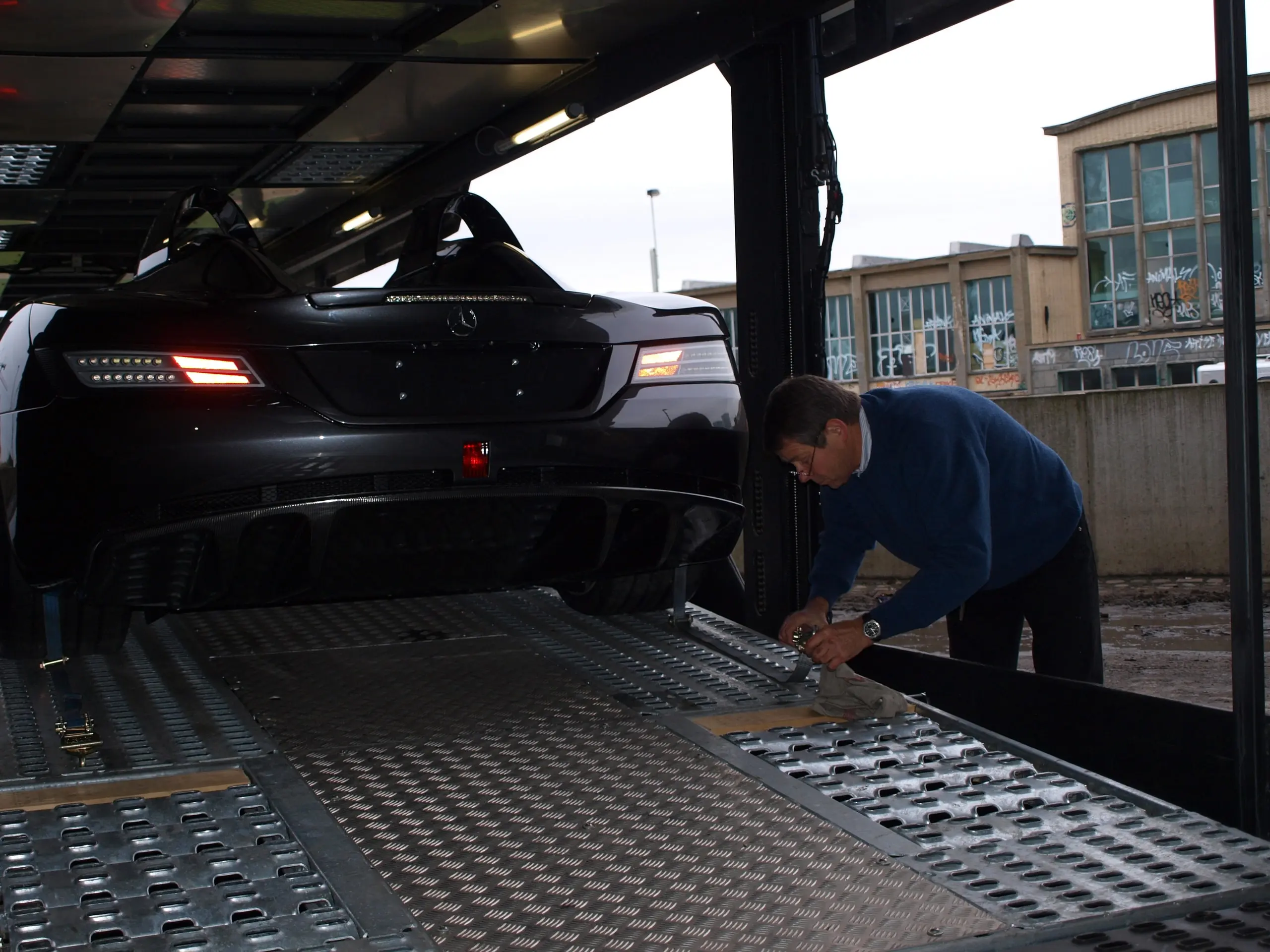
Insurance is decided at the moment of the inspection, not in the small print. Before departure, the driver carries out a full inspection and photographs the vehicle's condition. On delivery, the vehicle's condition is checked together and compared with those photos.
If something is wrong, precise reserves are recorded at delivery and the photo file does the proving for you. Without a condition record at both ends, establishing what happened — and when — becomes your problem. With it, the facts are already on paper.
Before you hand over your car: five questions to ask
- Are the coverage ceilings written down — per vehicle and per transport — or is it just “CMR included”?
- Does the coverage run from loading to unloading, with no gap in between?
- Who actually drives the truck? Subcontracting dilutes the chain of responsibility.
- Is the condition photographed at departure and arrival, and checked with you?
- Who do you call if something needs to be resolved — one contact, or a switchboard?
Insurance settled, route next
The full legal framework — CMR conditions, particular risk, scope of the service — is laid out in our terms and conditions. For how a journey itself unfolds, read our article on car transport across Europe.
Configure your transport online — insurance included in the proposal, firm answer in less than 24 hours — or call us on +32 2 347 40 30.